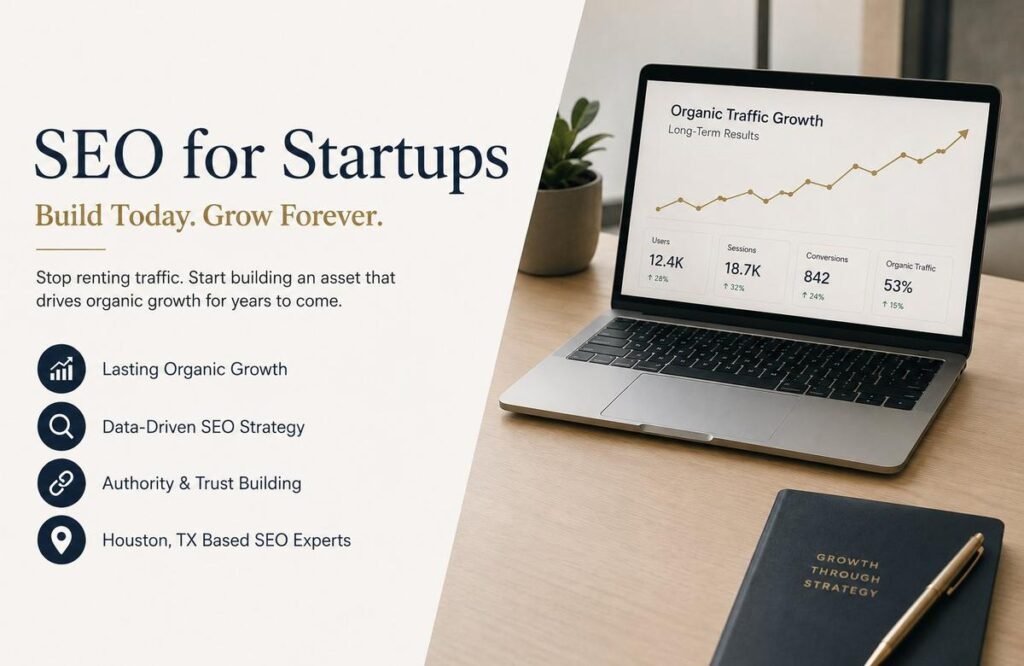
Most startups burn through their first marketing budget on paid ads. The clicks come in. The budget disappears. And the moment they stop paying, the traffic vanishes completely. Nothing is left behind. No rankings. No authority. No compounding return.
That’s the trap. And SEO for startups is the way out of it.
At Digital Oasis, we provide the best SEO Services that create lasting organic growth from day one. Based in Houston, TX. Google Certified Partner with 15+ years experience helping new businesses build real search visibility without wasting money on strategies that evaporate overnight.
Grab your free SEO audit today and find out exactly where your startup stands and what it needs to grow.
Why Most Startups Get Marketing Backwards
Here’s what typically happens. A startup launches. The founder needs customers fast. Someone suggests Google Ads or social media ads because they show results quickly. Money goes in. Some leads come out. Feels like it’s working.
Then the budget runs out or gets cut. Traffic drops to zero overnight. The startup is back to square one with nothing built to show for the spend.
SEO for startups works the opposite way. It’s slower to start but it builds something permanent. Every blog post that ranks, every backlink earned, every technical improvement made adds to an asset that keeps growing in value month after month.
According to HubSpot, organic search drives 53% of all website traffic across industries. Paid search drives just 15%. The math alone tells you where the real opportunity is for a startup with limited resources and a long-term vision.
What Makes SEO Different for Startups
SEO for startups isn’t the same as SEO for an established brand. The strategy has to match the stage of the business. What works for a company with five years of domain authority doesn’t work for a site that launched three months ago.
You Are Not Competing With Everyone Yet
That’s actually good news. New startups often panic when they see big competitors dominating search results. But those big competitors aren’t your real target right now. Your target is the specific niche, location, or problem space where you can realistically win.
A startup offering project management software for construction companies doesn’t need to beat Asana on day one. It needs to rank for “project management software for small construction companies.” Specific. Niche. Winnable.
Startups Have One Advantage Big Brands Don’t
Agility. Big brands take months to approve a new content piece. Startups can publish, test, and iterate in days. That speed is a genuine competitive advantage in SEO.
Fresh perspectives, original research, and founder-led content consistently outperform generic corporate blog posts. According to LinkedIn, content from individual founders gets 3 times more engagement than company page content. Use that. Write from experience. Share real numbers. Document what you’re learning. That kind of content earns links naturally and builds topical authority faster than anything else.
Building Your Startup SEO Strategy From Zero
Start With Keyword Research That Matches Your Stage
Our keyword research services always start with a reality check. What can your startup actually rank for right now given your current domain authority?
For most new startups that means long-tail keywords with lower search volume and lower competition. “Best CRM for freelance consultants under $50 a month” has less search volume than “best CRM” but it’s infinitely more winnable and the person searching it is much closer to buying.
Start narrow. Win those rankings. Build authority. Then expand into broader more competitive terms as your domain grows stronger. This is called the content hub model and it’s one of the most effective startup SEO strategies in modern search marketing.
Build Topical Authority Before Going Broad
Google rewards websites that demonstrate deep expertise in a specific topic area. This concept is called topical authority and it’s become increasingly important since Google’s Helpful Content updates.
Instead of writing random blog posts about anything loosely related to your industry, build clusters of content around one core topic. A central pillar page covering the broad topic in depth. Then multiple supporting blog posts going deep on specific subtopics. All linking back to the pillar and to each other.
This structure tells Google your site is a genuine authority on that topic. Not just another site with scattered blog posts. Topical authority built this way can move rankings faster for startups than almost any other content approach.

On-Page SEO Your Startup Can’t Skip
Every page needs proper on-page SEO optimization from the start. Title tags with your target keyword near the front and under 60 characters. Meta descriptions written to maximize click-through rate. One H1 per page. Clean heading hierarchy throughout.
Image compression and alt text on every visual. Internal links connecting related pages. Schema markup where relevant helps Google understand your content and display it as featured snippets.
Featured snippets are particularly valuable for startups. Ranking in position zero above all other organic results drives significant traffic even for newer domains. Structure your content to answer specific questions directly and concisely to target these placements.
Content Marketing Is the Engine Behind Startup SEO
You cannot separate content marketing from SEO for startups. They are the same strategy. Content is how you earn rankings, build authority, attract backlinks, and demonstrate expertise to both Google and potential customers.
What Type of Content Works for Startups
Not all content is equal. For startups specifically, certain content types consistently outperform others.
Original research and data are the highest-value content a startup can produce. Survey your users. Analyze your industry data. Publish findings with real numbers. This type of content earns backlinks naturally because other writers cite original data. One well-researched study can generate dozens of quality backlinks.
Comparison content performs exceptionally well for startups in competitive spaces. “Your product vs competitor” pages rank for high-intent searches from buyers in the final decision stage. These visitors are ready to choose. Being present at that moment with honest, helpful comparison content converts at a high rate.
Our content marketing services build both types into every startup SEO strategy we develop.
How to Turn One Idea Into Ten Pieces of Content
Resource efficiency matters for startups. You probably don’t have a ten-person content team. So every content idea needs to work as hard as possible.
One original research report becomes a blog post, a LinkedIn article, an infographic, a Twitter thread, a podcast episode summary, and five supporting blog posts going deeper on individual findings. That’s ten pieces of content from one research project.
This approach builds topical depth fast, creates multiple internal linking opportunities, and gives your digital marketing services team real content to promote across channels simultaneously.
Technical SEO for Startups
The Technical Checklist Every Startup Needs
Most startup websites have technical issues hiding beneath a clean surface. These issues silently suppress rankings without any obvious symptoms.Here’s what needs to be confirmed before anything else:
- Site speed under two seconds on both desktop and mobile. Google’s Core Web Vitals are now a ranking factor. A slow site loses rankings and visitors simultaneously.
- XML sitemap submitted through Google Search Console so Google knows every page exists and can index them properly.
- Mobile-first design confirmed because Google indexes the mobile version of your site first since its 2019 mobile-first indexing switch.
- No duplicate content issues from URL parameters, www vs non-www conflicts, or similar page variations that confuse Google about which version to rank.
According to SEMrush, 42% of websites have duplicate content issues hurting their rankings. Most owners have no idea. A proper technical audit catches all of it. Here are Top 10 Common Technical SEO Issues & How to Fix Them

Link Building on a Startup Budget
Backlinks remain one of Google’s top three ranking factors. New startups have zero. Building them takes time but it doesn’t have to take a massive budget.
Where Startups Get Their First Quality Backlinks
Digital PR is one of the most cost-effective link building strategies for startups. Write a press release about your launch, a unique product feature, or original research you’ve published. Distribute it to industry publications and local news outlets. Even two or three placements in credible publications can meaningfully move your domain authority early on.
Founder guest posting works exceptionally well. Pitch original bylined articles to industry blogs and publications that your target audience reads. Share genuine expertise and insights. Most publications accept well-written relevant pitches from credible founders.
Our link-building services combine digital PR, guest posting, local citations, and strategic directory listings to build a clean diverse backlink profile that grows your startup’s domain authority sustainably over time.
Local SEO for Startups Serving Specific Areas
If your startup serves a specific geographic market, local SEO services need to be part of your strategy immediately. Not eventually. Now.
Claim and fully optimize your Google Business Profile before anything else. Complete every field. Add real photos. Write a keyword-rich description. Post updates weekly. Actively collect reviews from every satisfied early customer.
76% of People who search for something local visit a business within a day, says Bright Local. Google Business Profile visibility is one of the highest ROI investments you can make if you’re a startup looking to grow a local customer base quickly.
Build location-specific landing pages if you serve multiple areas. Each one is uniquely written and optimized for that location’s keywords. Not copied templates with the city name swapped out. Google recognizes thin location pages and ignores them.

How to Measure SEO Progress as a Startup
Metrics That Actually Matter Early On
Most startups make the mistake of obsessing over rankings too early. Rankings matter but they’re a lagging indicator. Get organized with these metrics first.
Organic impressions in Google Search Console tells you how often your pages appeared in search results before people actually clicked. More impressions means Google is starting to surface and index your content. Early traction.
Click-through rate tells you whether your title tags and meta descriptions are exciting enough to earn clicks when they do appear. Google won’t bother if you’re not getting clicks. A low click-through rate means your copy is weak even if your positioning is strong.
Indexed pages show how much of your site Google has found and indexed. A new startup should be pushing to get every important page indexed within the first few weeks.
Leads from organic traffic are ultimately the metric that matters most. Track which organic visits convert into signups, demo requests, or purchases using Google Analytics goal tracking from day one.
When to Hire an SEO Agency as a Startup
Trust us on this one. The right time to hire an SEO agency is earlier than most startups think. Not when you’ve exhausted all other options. Not when you’ve spent six months doing it wrong yourself.
The earlier proper SEO foundations are laid, the faster results compound. Bad SEO work done in the early months is genuinely hard to undo later. Toxic backlinks, keyword cannibalization, thin content, and technical errors all get harder to fix as a site grows.
Our Google Ads management team runs parallel paid campaigns for startups that need immediate traffic while organic SEO builds momentum. Both channels together accelerate growth significantly compared to either alone. Paid ads feed you today. SEO feeds you for years.

Final Thought
Every startup is competing for attention in a crowded market. Paid ads get you noticed today but stop the moment your budget does. SEO for startups builds something fundamentally different. It builds an asset. A growing, compounding source of organic traffic that gets stronger every single month you invest in it. The startups that figure this out early are the ones that stop worrying about their next marketing budget because their website is doing the work for them around the clock.
At Digital Oasis we’ve helped startups go from zero visibility to page one rankings that drive consistent revenue. Your startup deserves that same foundation. Get your free audit today and let’s build it together.
For SaaS startups specifically, First Page Sage found a 702% ROI from SEO with a 7-month break-even point. Organic traffic is already the biggest traffic source for the top 50 SaaS companies — at 26.4% of all visits
Source: Link Quest
FAQs
Q: Is SEO worth it for startups with a small budget?
Definitely. In general, startup SEO is more cost effective than paid advertising. The reason is results compound over time while paid advertising are quick, dirty, and mostly vanish when you stop paying. Even a small monthly SEO fee builds a set of assets that can generate traffic and leads for years to come. You need to get early and be consistent.
Q: How long does SEO take to work for a startup?
Most startups see initial small movements in keywords and keyword impressions growth in four to eight weeks of proper on-page and technical groundwork completed. Real organic traffic will typically build in months three to six. On competitive keywords in established markets, you’re looking six to twelve months for steady page one rankings.
Q: How do startups do SEO with a small budget?
Start with the low competition long tail keywords. Create topical authority by creating high-quality content. Earn backlinks through digital PR and guest posting by founders. Fix all technical issues. Those strategies take time, not money. It’s possible to get good results, and you don’t need to spend a lot of money to get started.
Q: What is the first SEO step for a new business?
The technical foundation is always first. First make sure that your site loads quickly, is optimized for mobile, and that you have submitted your site to Google search console. If you don’t have a solid technical foundation, everything you do thereafter is fighting against friction. Get the foundation in place first and everything else compounds up properly.